Meet Arwen: Our Dedicated Speech and Language Therapist
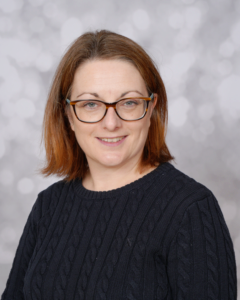
Arwen Derham is an experienced Speech and Language Therapist (SaLT) who works at Stone Bay School two days per week, bringing a wide knowledge base and a holistic child-centred approach to therapy.
The fundamental aim of Speech and Language Therapy is to enable people of all ages to communicate as effectively and independently as possible. A key aspect of Arwen’s work is to ensure that Stone Bay school is promoting inclusive communication. This means the way in which each pupil chooses to communicate (such as speech, signs, gestures or using visual aids) is respected and valued.
In her role, Arwen works directly with children, as well as through staff, to enable each pupil to achieve key outcomes including:
- Expressing their thoughts, opinions, and ideas.
- Interacting with others.
- Engaging fully with their learning.
Arwen works closely with the Therapy Team to better understand the child’s strengths and areas where a child may be experiencing communication difficulties. This information is then used to support the development of their language and communication skills.
At Stone Bay, Arwen provides input across the universal, targeted, and specialist levels of provision. Her involvement includes observing pupils in their learning environments, providing advice and recommendations to staff on fostering communication and staff training.
Key Speech and Language Approaches and Interventions
Pupils at Stone Bay School will benefit from a range of speech and language approaches and they may participate in various speech and language interventions, such as:
- The communication friendly environment focuses on the physical space across the school and the interactions with the students. Communication tools are used to support the development of relationships, engagement in learning and well being. The space is designed to reduce barriers to communication and create opportunities for students to share their thoughts, ideas and opinions. Examples of communication tools include:
- Visual timetables
- Now and next boards
- Symbols on lanyards
- Communication boards around the school
- Choice boards
- Clearly defined spaces
- Communication boards
|
- Augmentative and Alternative Communication (AAC). Students are encouraged and taught the skills needed to express themselves using a range of tools, strategies and systems e.g.
- Makaton is a language programme that uses signs, together with speech and symbols, to enable pupils to communicate. It supports the development of essential communication skills such as attention, listening, comprehension, memory and expressive speech and language.
- PECS (Picture Exchange Communication System) is an alternative, augmentative communication system. Pupils learn to exchange a symbol or combination of symbols to make requests or comments.
- Communication boards and books use pictures and symbols to give pupils opportunities to learn core word vocabulary and later on, sentence structures, as well as increase opportunities for them to ask for something, make a comment, share their opinions and preferences, tell us what they need, make choices etc.
- Voice Output Communication Aids (VOCAs) are electronic devices that help pupils who cannot speak clearly. They work by letting the user choose pictures, symbols or letters on a screen (like pressing a button) and the device then speaks the message out loud using recorded or computer-generated speech.
- Talking Mats are a visual communication tool. Pupils organise pictures on a mat to share their thoughts, feelings and views on topics. This structured approach empowers children and young people, often leading them to feel more heard and valued.
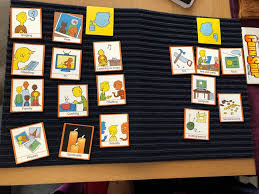
(Picture of a Talking Mat)
- Intensive Interaction is an approach to help pupils at early levels of development. Intensive Interaction is an established, evidence-based approach that works on early interaction abilities - how to enjoy being with other people, to relate, interact, know, understand and practice communication routines.
The method involves a facilitator engaging the individual in playful, highly responsive sessions. The facilitator imitates the individual's sounds, movements, and facial expressions, acting like a mirror.
This child-led, non-pressured mirroring teaches the fundamental elements of communication: that their actions have meaning, how to share attention, and how to enjoy the back-and-forth rhythm of conversation (turn-taking). This builds self-awareness and lays the groundwork for better relationships and engagement.
- Attention Autism is a highly effective, fun, and evidence-based educational approach that helps children, particularly those with Autism, develop natural attention and concentration skills using visually exciting activities. By making activities motivating and predictable, Attention Autism naturally encourages children to look, listen, and wait, building communication and social skills through shared enjoyment.
- Identiplay is an approach that helps to establish a shared focus between child and adult. By doing this, it supports the development of imitation skills, which in turn builds children’s confidence as they practice a new skill. It also helps to develop communication and play skills.
|
If you have any concerns about your child's speech, language and communication, please contact their class teacher. They will be able to share information about the strategies and approaches that are currently being used to support your child. They can also refer your child for discussion with the Therapy team to consider what further support may be available.